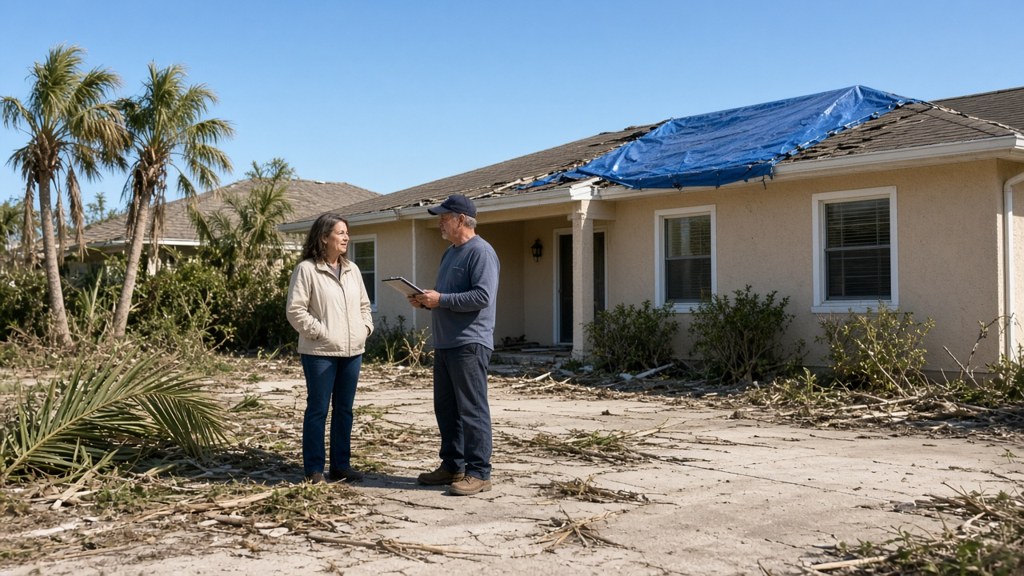
Hiring a contractor after a hurricane in Jacksonville starts with three checks: the right license for the work, a written price, and payments tied to work you can see. Northeast Florida homeowners can do much of that work before a storm arrives. This guide covers what recent storms showed about risk in Duval, St. Johns, Clay, Nassau, and Baker counties, the local and state license checks, the roof contract rules Florida adds after a declared emergency, and how to pay for repairs by phase.
Hurricane season runs from June 1 to November 30, and NOAA puts the peak on September 10. The steps below work in any month.
Key takeaways
- Hurricane season in Jacksonville runs June 1 through November 30, and storm recovery brings unlicensed operators into Northeast Florida neighborhoods.
- More than 68% of Duval County housing units were built before 2000, making pre-storm photos and saved license checks especially valuable.
- Match the contractor's Florida license to the exact repair, separate emergency tarp crews from roof replacement contracts, and verify permit plans.
- Read Florida roof contracts carefully for statutory cancellation notices and never accept cash or gifts tied to an insurance roof inspection.
- Keep storm repair funds protected inside UGO PROS so payments release only after you inspect and approve completed phases.
What did Hurricane Irma show about storm risk in Jacksonville?
Northeast Florida does not need a direct landfall to see serious damage. On September 11, 2017, Hurricane Irma's eye passed well west of Jacksonville, yet the St. Johns River at the Main Street Bridge in downtown Jacksonville crested at 5.57 feet NAVD88 around 12:30 p.m. That was an all-time record, above the 4.12-foot mark set by Hurricane Dora in 1964 (National Weather Service Jacksonville, Hurricane Irma post-storm report, September 2017).
The same report lists about 350 water rescues in Duval County, mostly in Riverside, San Marco, and downtown Jacksonville. The Jacksonville International Airport station measured a wind gust of 86 mph, and a home in the San Souci neighborhood lost its roof. In St. Johns County, the report lists storm surge and multiple tornadoes, and in Baker County, large trees were blown down. NOAA's Storm Events Database adds that coastal infrastructure already weakened by Hurricane Matthew the year before took the most damage from Irma's surge (NOAA National Centers for Environmental Information, 2017).
| Irma in Northeast Florida (September 2017) | What was reported |
|---|---|
| Duval County | Record St. Johns River crest at the Main Street Bridge, about 350 water rescues, 86 mph gust at the airport |
| St. Johns County | Storm surge, multiple tornadoes, roofs blown off buildings |
| Baker County | Many trees down, including large trees near Macclenny |
Source: National Weather Service Jacksonville, Hurricane Irma post-storm report, September 2017.
How old are the homes in Northeast Florida?
Older homes were built under earlier wind and structural codes, long before modern hurricane-strap and roof-deck attachment standards. The first statewide Florida Building Code took effect on March 1, 2002 (Florida Building Commission), and in Duval County alone, 68.2% of housing units were built before 2000. That means more than two out of three Jacksonville homes predate the statewide code, raising the odds of hidden roof-decking gaps, older electrical panels, or unbraced garage doors during storm recovery.
| County | Housing units | Built before 2000 | Median year built |
|---|---|---|---|
| Duval (Jacksonville) | 454,740 | 68.2% | 1986 |
| Clay | 88,969 | 57.9% | 1996 |
| Baker | 10,148 | 55.3% | 1996 |
| Nassau | 45,058 | 50.5% | 2000 |
| St. Johns | 133,504 | 41.6% | 2004 |
Source: U.S. Census Bureau, American Community Survey 2020-2024 5-year estimates, Tables B25034 and B25035. Percentages calculated by UGO PROS. Even in faster-growing St. Johns County, over 41% of homes predate 2000, making pre-storm photos and verified contractor scopes essential across all five Northeast Florida counties.
What should Jacksonville homeowners do before a storm?
Step 1: Photograph your home now
Take dated photos of the roof, windows, doors, fences, and the inside of each room. Photos from before a storm make it easier to show what changed.
Step 2: Get pre-season work done early
Roof repairs, tree trimming, and window or door work are easier to schedule before the peak of the season. Post the project on UGO PROS and compare pre-quotes from verified pros.
Step 3: Save your license lookups
Bookmark MyFloridaLicense.com, the free DBPR lookup, and the City of Jacksonville's Contractor License and Complaint Search page. The city page links to state license searches, Duval County license searches, and the Duval County Clerk's official records, where judgments against contractors are kept (City of Jacksonville Building Inspection Division, 2026).
How do I check a contractor in Jacksonville after a storm?
Step 1: Match the license to the work
Search the contractor on MyFloridaLicense.com and confirm the license is active and covers the work. In Duval County, the Construction Trades Qualifying Board also issues local contractor certificates for trades that include roofing, general building, residential, electrical, plumbing, and air conditioning work (City of Jacksonville, Construction Trades Qualifying Board, 2026). Unlicensed contracting during a declared state of emergency is a third-degree felony in Florida (F.S. 489.127(2)(c), 2026).
Step 2: Find the license number on the paperwork
Florida law requires a contractor's registration or certification number in each offer of services, bid, contract, and advertisement (F.S. 489.119(5)(b), 2026). A flyer or door hanger with no number is a reason to keep looking.
Step 3: Confirm the permit plan
The City of Jacksonville takes permit applications online through its JaxEPICS system for all permit types (City of Jacksonville Building Inspection Division, 2026). Even a small single-family roof repair or reroof of five squares or less, or $2,500 or less, still needs a paid permit, though it skips plan review and scheduled inspection (Jacksonville Ordinance Code, Section 320.408(f)). Outside Jacksonville, ask the contractor which building department covers your address.
Step 4: Separate the tarp crew from the roof crew
A temporary tarp and a permanent roof repair are different jobs. In the Hurricane Isaias emergency order, DBPR said a non-permanent emergency tarp installed under the exemption in Section 489.103(6) does not need a state contractor's license, while a permanent repair still does (Florida DBPR, Isaias contractor fact sheet, October 2026). That order covered 30 counties, including Baker County in Northeast Florida. Duval, St. Johns, Clay, and Nassau were not on its list.
Step 5: Read every roof contract for the cancellation notice
If your home is in the area covered by a declared emergency and you sign a roof repair or replacement contract within 180 days of the events behind the declaration, Florida law lets you cancel without penalty within 10 days after signing or by the official start date, whichever comes first (F.S. 489.147(6)(a), 2026).
Step 6: Decline gifts or cash for a roof inspection
Florida law bars contractors from offering a rebate, gift, cash, or waiver of an insurance deductible in exchange for a roof inspection or a roof claim (F.S. 489.147(2)(b), 2026). Questions about a claim or your coverage belong with your insurance company.
Step 7: Pay only for work you can see
Tie each payment to a stage you can check, such as materials delivered or a phase finished. Keep dated photos of the damage and of each finished stage.
"After a storm, the first person to knock on your door is not always the one to hire. Check the license, get the price in writing, and never pay for work you have not seen," said Jason Jones, Founder of UGO PROS.
UGO PROS is a two-sided home services marketplace that connects homeowners with verified pros, the contractors who have passed UGO PROS verification. The company currently operates throughout Florida. Quotes, messages, photos, and approvals all live in the same project record so both sides can follow the work. UGO PROS verifies each contractor's insurance and any license Florida requires before the contractor can accept a project, and it keeps a timestamped record of the messages, photos, and approvals on every project. The UGO PROS app was rebuilt and relaunched in 2026. It is free to download, free to post your job, and free to bid.
Common mistakes
Post-storm confusion in Jacksonville gives unlicensed operators their easiest opening.
- Waiting until a hurricane watch to photograph your roof, rooms, and saved Florida DBPR license lookups.
- Hiring a door-to-door crew after a storm without checking whether their license covers structural roofing.
- Signing a single contract that bundles emergency tarping with a full roof replacement.
- Skipping Florida's statutory cancellation notice on a post-storm roofing agreement.
- Accepting gift cards, rebates, or cash offers tied to an insurance roof inspection, or paying before work is visible.
Jacksonville homeowners who prepare photos, saved DBPR license lookups, and written scope expectations before storm season make faster, safer decisions when neighborhood cleanup calls begin.
Advance preparation and verified credentials protect Jacksonville homeowners when storm repairs begin.
How do UGO PROS payments help with storm repairs?
When you accept the final quote, the money moves from your account to ours, where it's kept safe. It's only released when the job is complete, or when a phase you both agreed on is complete. We hold your funds safely so you never get scammed again. A roof replacement on UGO PROS is paid in three stages: a first payment to pull the permit, a second payment after the shingles are delivered, and the rest after the final inspection. Most verified pros on UGO PROS today are based in Jacksonville.
- Download the free UGO PROS app: UGO PROS is free to download, and it is free to post your job. Download the free UGO PROS app at ugopros.com/join/Jaxnow.
- Verification: UGO PROS checks each contractor's proof of insurance and any trade license Florida requires before the contractor can accept projects.
- Posting: You post the project and describe the work.
- Quotes: Verified pros send a pre-quote, a price estimate made before visiting your home. A contractor can instead request an on-site visit, and you must approve the visit. After you and the contractor agree on a price face to face, the contractor sends a final quote through the app. You compare each contractor's profile, past work, and reviews, and then accept one final quote.
- Funding:
- Progress: The contractor completes the work in phases and posts photos and messages in the project record.
- Approval: When you approve a phase or the final job, UGO PROS releases the payment for that work to the contractor. Before you approve, you can review the photos and messages and ask for adjustments. If the contractor marks the job complete and you neither confirm it nor file a dispute within two weeks, UGO PROS releases the payment automatically.
- Review: When the project ends, you and the contractor rate each other.
What does UGO PROS cost a homeowner?
You pay nothing to download the free UGO PROS app, post your storm recovery project with photos, or compare written pre-quotes from verified pros in Jacksonville and across Northeast Florida. In-app messaging, progress photo logs, and written change-order approvals also cost nothing extra.
Bidding is free. UGO PROS only takes a tiny fee when the job is funded.
Before you accept a final quote, review it line by line against your agreed scope so roofing license match, tarp separation, statutory cancellation notices, and permits are all written down clearly. When you accept the final quote, the money moves from your account to ours, where it's kept safe. It's only released when the job is complete, or when a phase you both agreed on is complete. We hold your funds safely so you never get scammed again. If an issue comes up during the work, flag it inside the app while the disputed phase remains protected rather than paying off-platform.
Frequently Asked Questions
When is hurricane season in Jacksonville?
Hurricane season runs from June 1 to November 30, and NOAA puts the peak on September 10. Northeast Florida can see major flooding and wind damage without a direct landfall, as Hurricane Irma showed in September 2017.
How do I check a contractor's license in Duval County?
Search the contractor on MyFloridaLicense.com, then use the City of Jacksonville's Contractor License and Complaint Search page for Duval County licenses and court records. Make sure the license number appears on the quote.
Can I cancel a roofing contract after a hurricane in Florida?
If your home is in the declared emergency area and you signed the contract within 180 days of the events behind the declaration, Florida law lets you cancel without penalty within 10 days after signing or by the official start date, whichever comes first (F.S. 489.147(6)(a)).
How do I find a verified roofer in Jacksonville?
Post your roofing project on UGO PROS, and verified pros who serve your area send pre-quotes. UGO PROS confirms each contractor's insurance and any license Florida requires before the contractor can accept a project.
Sources
- National Weather Service Jacksonville, Hurricane Irma post-storm report, September 2017.
- NOAA National Centers for Environmental Information, Storm Events Database, Duval County, September 2017.
- City of Jacksonville Building Inspection Division, Contractor License and Complaint Search and Online Permit Submission pages, 2026.
- City of Jacksonville, Construction Trades Qualifying Board page, 2026.
- Jacksonville Ordinance Code, Section 320.408.
- Florida DBPR, Emergency page and Isaias contractor fact sheet (Emergency Order 2026-01 as amended by 2026-02), October 2026.
- Florida Statutes, Sections 489.103, 489.119, 489.127, 489.147 (2026), Florida Senate.
- U.S. Census Bureau, American Community Survey 2020-2024 5-year estimates, Tables B25034 and B25035.
- Florida Building Commission, history of the Florida Building Code (first edition effective March 1, 2002).
Summary: storm-ready in Northeast Florida
- Photograph your home and finish pre-season repairs early.
- Check the state license and, in Duval County, the local certificate.
- Confirm the permit and look for the 10-day cancellation notice on any roof contract.
- Pay only for work you have seen.
Download the free UGO PROS app, then post your job for free and compare pre-quotes from verified pros: ugopros.com/join/Jaxnow.
Restoring trust. Protecting both parties.
About the author
Written by Jason Jones, Founder of UGO PROS.
Published November 18, 2026. Last updated November 18, 2026.
Jason Jones is the Founder of UGO PROS, a Florida home services marketplace app that connects homeowners with verified pros. UGO PROS verifies each pro's insurance and any license Florida requires, and most verified pros on the platform today are based in Jacksonville.
Disclosure: I am the founder of UGO PROS, the Florida home services marketplace described in this article.